W-2 Employee or 1099 Contractor: What the Difference Costs You
The same remote job can be offered as W-2 employment or as 1099 contract work, and the two are not worth the same money. This post covers the taxes, the missing protections, the legal tests and how to compare the rates.

Steven Schulz
· 7 min read
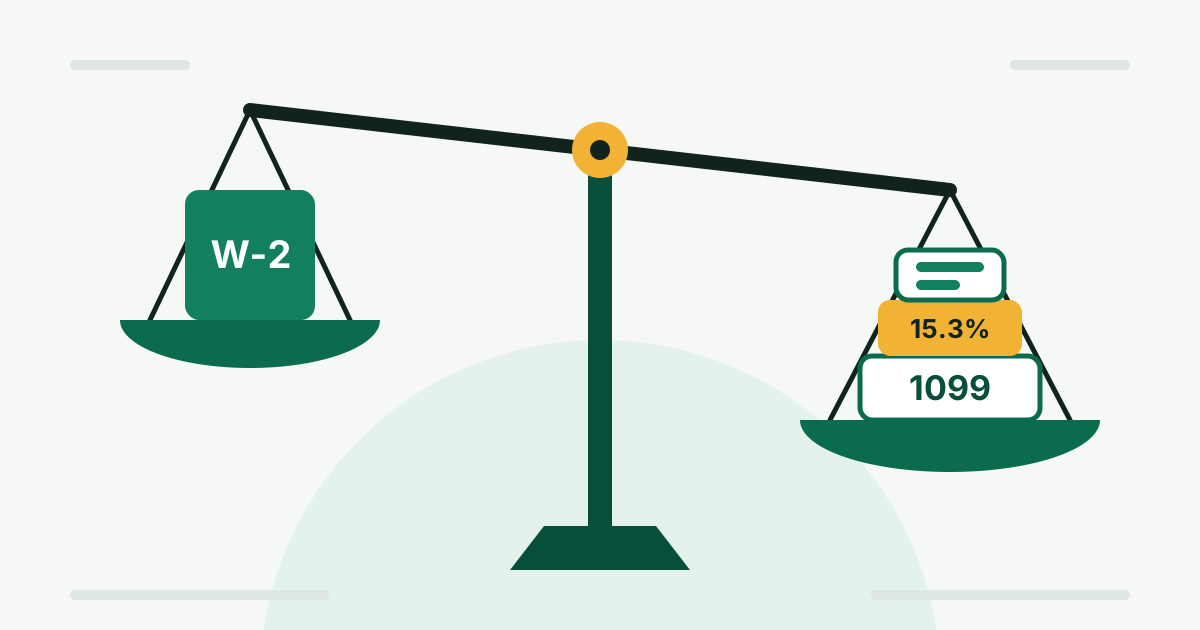
A W-2 employee and a 1099 contractor can do identical work for the same company and take home very different amounts. As a contractor you pay both halves of Social Security and Medicare, fund your own benefits, lose most employment protections and handle your own tax payments during the year. None of that makes contract work a bad deal, but it means a contract rate has to be clearly higher than the equivalent salary before the two are even.
What the two labels mean
The names come from tax forms. An employer reports an employee's wages on Form W-2 and withholds taxes from every paycheck. A business reports payments to an independent contractor on Form 1099-NEC and withholds nothing. For payments made after December 31, 2025, the reporting threshold is $2,000 in a calendar year, up from $600. The threshold governs the payer's paperwork only; you owe tax on self-employment income whether or not a form arrives.
One hybrid confuses the picture: the "W-2 contract" role. You work for a client for a fixed term but are employed by a staffing agency, which withholds taxes and pays the employer share. Legally you are the agency's employee, and this post's contractor costs do not apply to you.
What changes in your taxes
Both halves of Social Security and Medicare
An employee pays 6.2 percent of wages for Social Security and 1.45 percent for Medicare, and the employer pays the same again. A self-employed person pays both shares as self-employment tax. The rate is 15.3 percent: 12.4 percent for Social Security and 2.9 percent for Medicare. For 2026 the Social Security part applies to the first $184,500 of combined wages and net self-employment earnings; the Medicare part has no cap, and an additional 0.9 percent applies above $200,000 for a single filer.
Two details soften this slightly. The tax is figured on net earnings, after business expenses. And you can deduct the employer-equivalent portion when calculating your income tax.
Paying during the year
Nothing is withheld from a contractor's invoices. The IRS expects estimated tax payments in four installments if you expect to owe $1,000 or more when you file. You generally avoid an underpayment penalty if you have paid at least 90 percent of the current year's tax or 100 percent of the prior year's, whichever is smaller. Most states with an income tax want their own estimated payments too; see the post on remote work and state taxes.
Deductions
Contractors report income and expenses on Schedule C and can deduct ordinary business costs: software, equipment, a qualifying home office. Employees cannot deduct unreimbursed work expenses on a federal return under current rules; the post on home office setup and stipends covers that side.
What you give up besides the tax
| W-2 employee | 1099 contractor | |
|---|---|---|
| Social Security and Medicare | Split with employer | You pay both shares |
| Tax withholding | Done by employer | Estimated payments by you |
| Minimum wage and overtime | Covered by the FLSA | Not covered |
| Unemployment insurance | Generally covered | Generally not covered |
| Workers' compensation | Generally covered | Generally not covered |
| Health insurance, 401(k) match | If the employer offers them | Yours to arrange and fund |
| Paid vacation, holidays, sick time | Per policy and state law | Unpaid |
The row people underestimate is unemployment insurance. Regular state unemployment benefits are built on wages an employer reported and paid tax on. When a contract ends, there is usually no claim to file. If you are choosing contract work shortly after a layoff, check with your state agency how it affects a current claim; the post on the first month after a layoff goes into this.
Health insurance and retirement are the second gap: a contractor buys coverage individually and funds retirement alone. The post on benefits in a remote job explains what an employer's share is worth.
Who decides which one you are
Not the contract, and not the company's preference. Classification follows the facts of the relationship, and several different tests apply at once.
The IRS looks at the common-law rules in three categories: behavioral control (does the company control what you do and how), financial control (who provides tools, how you are paid, whether expenses are reimbursed), and the type of relationship (contracts, employee-type benefits, whether the work is ongoing).
The Department of Labor applies an "economic reality" test under the Fair Labor Standards Act, asking whether you are economically dependent on the company or in business for yourself. Its Fact Sheet 13 lists six factors, among them control, permanence and the worker's opportunity for profit or loss. The same page states that receiving a 1099 or signing a contractor agreement does not make someone an independent contractor.
The federal standard is in motion. A 2024 rule set out the six-factor analysis. In May 2025 the department told its investigators to stop applying that rule in enforcement, while noting it remains in effect for private lawsuits. In February 2026 it proposed a replacement. As of mid-November 2026 the department's rulemaking page shows no final rule, so check that page for the current status.
States run their own tests for wage law and unemployment insurance, and some are stricter. California presumes a worker is an employee unless the hiring business proves all three parts of its ABC test: the worker is free from the company's control and direction, the work is outside the usual course of the company's business, and the worker is customarily engaged in an independently established trade or business of the same kind. Certain occupations are exempt and judged under an older multi-factor test.
Signs that a "contractor" role is really a job
- Fixed hours set by the company, mandatory daily meetings, a manager who directs how the work is done.
- Full-time, open-ended, one client only.
- The company supplies the laptop, the tools and the email address.
One or two of these prove nothing. Most of them together describe employment paid on the wrong form. In remote hiring this happens for a specific reason: a company that is not registered as an employer in your state may offer a 1099 arrangement to avoid registering, which is the background to why remote jobs are limited to certain states. The convenience is theirs; the tax bill and the missing protections are yours.
If you believe you are misclassified, the IRS accepts Form SS-8 from workers and will determine your status, though it says a determination can take at least six months. Form 8919 lets a misclassified worker report only the employee share of Social Security and Medicare tax. For wage claims the route is your state labor agency or the Wage and Hour Division. Talk to a tax professional or an employment lawyer before acting, since the right step depends on your facts.
Comparing a contract rate with a salary
To compare the two, rebuild what the employer pays for an employee and divide by the hours you can actually bill. Here is the arithmetic for an invented example; replace every number with your own.
A W-2 offer of $120,000 a year, with these employer-paid extras:
- Employer share of Social Security and Medicare, 7.65 percent: $9,180
- Employer's share of health premiums, example figure: $7,000
- Retirement match of 4 percent, example figure: $4,800
Total: $140,980. An employee is paid for 2,080 hours a year including vacation and holidays. A contractor who takes the same four weeks off and ten holidays bills about 1,840 hours.
- W-2 equivalent hourly pay: $120,000 ÷ 2,080 = about $58
- Contract rate needed to match: $140,980 ÷ 1,840 = about $77
In this example the contractor needs a rate roughly a third higher just to break even, before counting gaps between contracts or the absence of unemployment insurance. If a company offers "the same $58 an hour, but as 1099," it is offering a pay cut.
For the salary side of the calculation, the post on reading a salary range explains published ranges, and the salary pages show what employers publish for a given role.
When contracting is the right choice
Contract work suits you when you have, or want, several clients; when the rate reflects the costs above; when you have health coverage from another source; or when a short contract is a way into a company or a field. It is a poor fit when the role is a full-time job in everything but the paperwork and the rate does not make up for it.
What to do next
- Ask the recruiter early: "Is this W-2 or 1099, and who is the employer of record?" A posting that does not say is not unusual; a recruiter who will not say is a warning sign worth checking against the red flags for remote job scams.
- Run the comparison above with your own numbers before you discuss a rate.
- If you take a 1099 role, open a separate account for taxes, set up estimated payments in the first quarter and keep a record of expenses from day one.
- If the arrangement looks like employment, say so before signing and ask whether a W-2 option exists.
- For anything that affects your tax return or your legal rights, get advice from a professional who knows your state.