Geographic Pay Zones: Why the Same Remote Job Pays Differently
Many remote employers pay the same role differently depending on where the employee lives. This post explains how pay zones are built, how to tell which model a company uses, and what happens to your salary when you move.

Steven Schulz
· 7 min read
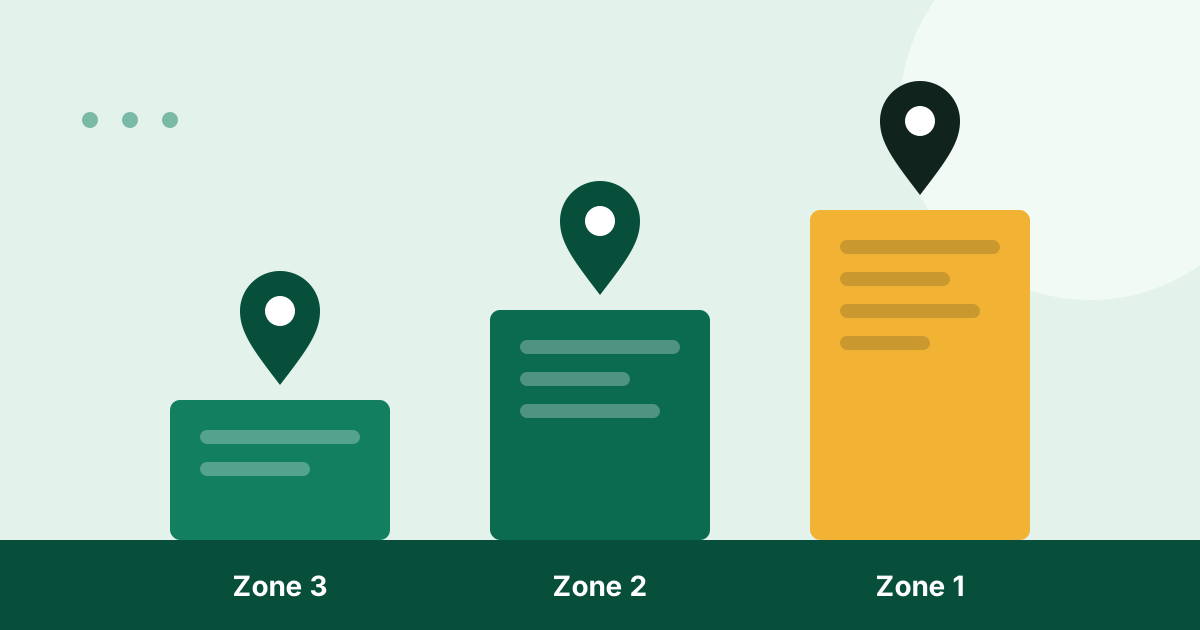
Two people with the same title, the same manager and the same performance rating can be paid tens of thousands of dollars apart at a remote company, and the only difference is their home address. That is not an accident or a secret; it is a pay policy, usually called geographic pay zones or location-based pay. Knowing how the zones are built tells you what a posting's range means for you, what to ask a recruiter, and what a move would cost.
How pay zones work
A company with location-based pay sorts every place its employees live into a small number of groups, typically two to five. Each group gets its own salary range for every job level. Zone 1 holds the most expensive labor markets, the last zone holds everywhere else.
The usual mechanics:
- The company sets a reference range for each level, most often tied to its highest-paying market.
- Each lower zone is expressed as a percentage of that reference, for example 100, 90 and 80 percent. The steps differ from company to company.
- Your zone is determined by your home address, usually by metropolitan area or county, sometimes by state.
- Your zone affects the range you are hired into. It normally does not affect your level, your bonus percentage or your benefits.
Some companies apply the zones only to base salary and grant the same equity everywhere. Others scale equity too. That detail is worth asking about, because at a company where stock is a large share of the package, a flat equity grant narrows the real gap between zones considerably.
Cost of labor, not cost of living
The most common misunderstanding is that zones track what it costs to live somewhere. They do not. They track what employers in that area pay for the same work: the cost of labor.
The two often move together, but not always. A metro area can be expensive to live in and still have modest pay for a given profession if few employers compete for those people there. The opposite also happens: a mid-priced city with a cluster of large technology employers can sit in a top zone for engineers and a middle zone for everyone else.
This has practical consequences:
- Arguing that your rent went up will not move your zone. Arguing that employers in your area pay more for your role might move your offer within the zone.
- Zones can differ by job family. A company may pay software engineers on a national scale because it competes nationally for them, and pay customer support on local scales.
- Zones get revised. Companies buy market data every year and occasionally re-sort cities. An address that was zone 2 when you were hired can become zone 3, typically without a pay cut for existing employees but with smaller raises until the band catches up.
The three models you will meet
Remote employers have settled on three broad approaches. None is right or wrong; each suits a different kind of company and a different kind of employee.
| Model | How it works | Good for you if | Watch for |
|---|---|---|---|
| Location-based zones | Range depends on where you live | You live in a top-zone area | Pay may change if you move |
| Single national range | One range for the role anywhere in the US | You live outside the big metros | Range is often set below top-market pay |
| National range with premiums | One base range plus an add-on for a few named metros | You want a predictable baseline | The premium list is short and can shrink |
Location-based zones
This is the most common model at larger companies. It lets them hire in expensive cities without paying those rates everywhere.
Single national range
Some companies, often smaller and remote from the start, pay one range regardless of address. They choose a market to benchmark against (sometimes a top market, more often something close to a national median) and apply it to everyone. If the benchmark is a high-paying market, employees in lower-cost areas do very well. If it is a national median, the company will struggle to hire in the most expensive cities and will tend to employ people elsewhere.
National range with premiums
A middle path: one range for the whole country, plus a fixed premium for a short list of high-cost metros. It is easy to explain and easy to administer, which is why it has gained ground with mid-sized employers.
How to spot the model in a posting
You can usually tell which model a company uses before talking to anyone.
- Several ranges listed by zone or by city. Location-based pay, stated openly. This is the most helpful kind of posting: find your area and read your range.
- One wide range plus "depending on location". Location-based pay, with the zones merged into one line. The bottom is the lowest zone's minimum and the top is the highest zone's maximum. How to take such a range apart is covered in how to read the salary range in a job posting.
- A range followed by "for candidates in" a list of states. The published figure may apply only to states whose laws require disclosure, and often those are the higher-paying ones. Pay elsewhere may be lower. The state rules behind this are in pay transparency laws by state.
- One moderate range and a sentence such as "we pay the same regardless of location". A national range. Companies that do this tend to say so, because it is a selling point.
- A list of eligible states. This is a different matter from pay zones. Hiring restrictions exist for tax and registration reasons, explained in why remote jobs are limited to certain states.
If the posting does not make it clear, ask in the first call: "Do you adjust pay by location, and if so, what is the range for this level where I live?" It is a routine question. A recruiter who cannot answer it will find out.
What happens when you move
For employees at companies with zones, this is where the policy becomes personal. The typical rules:
- You must report the move. Your address determines tax withholding and the state rules your employer has to follow, so a move is never just a private matter. See remote work and state taxes.
- Moving to a lower zone often means a pay adjustment. Some companies reduce salary to the new zone's range right away, some hold your pay and freeze raises until the lower band catches up, and some adjust only at the next review cycle.
- Moving to a higher zone does not always raise your pay. Many policies require approval for a move into a more expensive zone, and some grant the increase only if the business has a reason to want you there.
- Some destinations are not allowed at all. If the company is not set up as an employer in the state you want to move to, the answer may be no, or the move may end the job.
Read the policy before you sign, not when the moving truck is booked. Ask for the written relocation or location policy along with the offer. If you already know you intend to move within a year or two, say so during the offer stage and get the zone treatment confirmed in writing.
An example: a data analyst at a 600-person company lives in a zone 1 metro and earns $120,000. The company's zones step down by 10 percent. A move to a zone 3 city would put the same level's range 20 percent lower. Under an immediate-adjustment policy the salary drops to about $96,000. Under a hold-and-freeze policy it stays at $120,000 with no raises until the zone 3 band rises to meet it. Same move, two very different outcomes.
Negotiating inside a zone
Your zone is rarely negotiable. Your position inside the zone's range usually is.
- Find out your zone's range for your level first. Without it you are negotiating against the wrong numbers.
- Compare it with what other employers publish for the role. The salary pages on this site are built from ranges employers published in their own postings, for example for data scientists.
- If you hold an offer from a company with a national range that beats your zone's range, say so. A competing offer is the one argument that sometimes moves a candidate above the band, or up a level.
- Ask whether equity and sign-on bonus are zoned. If they are not, they are the natural place to ask for more.
The broader approach is covered in negotiating a remote job offer.
Which model suits you
A blunt rule of thumb: live in a top-zone area and plan to stay, and zoned employers will usually pay you more than national-range employers. Live somewhere less expensive, or expect to move, and a single national range is worth more to you than its headline number suggests, because it travels with you.
Think about the next five years, not only the offer. A zoned salary anchored to an expensive city is an asset you lose when you leave. A national-range salary is one you keep.
What to do next
Work out your own position before the next application. Check how the employers you are interested in describe pay and location in their postings, note which model each one uses, and write down the range for your level and area where it is published. When an offer arrives, ask for the location policy in writing along with it.