Remote Work and State Taxes: Living in One State, Working for Another
When your employer sits in one state and your desk in another, state income tax follows rules most people have never had to think about. This post explains which state taxes your pay, the exceptions that cause double withholding, and what to check.

Steven Schulz
· 7 min read
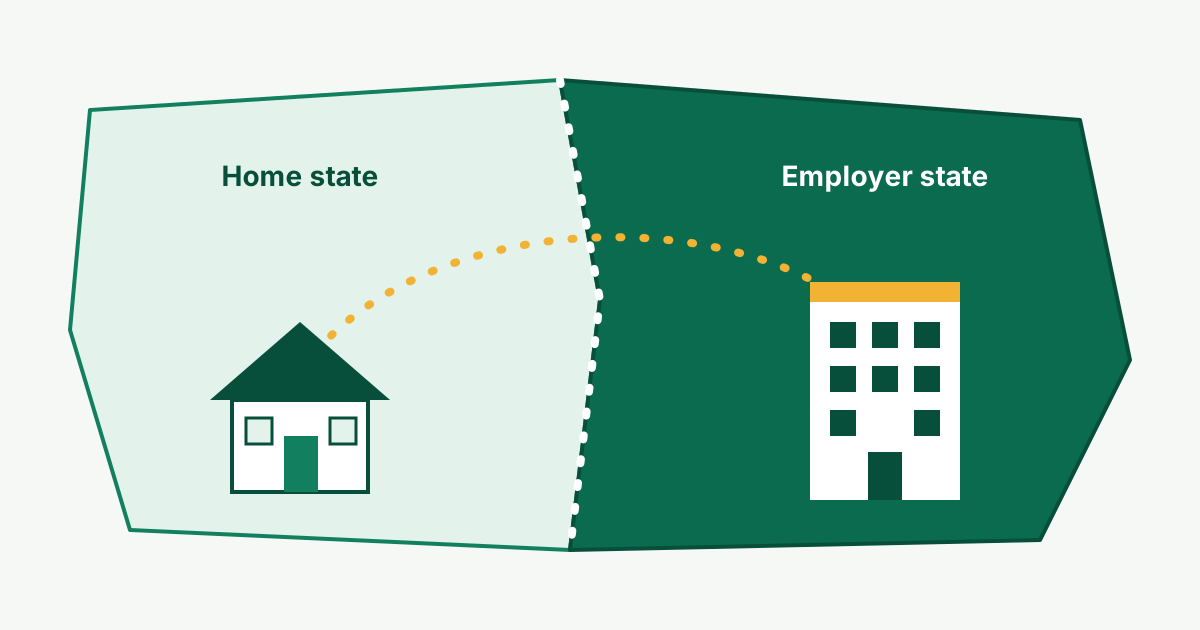
For most remote employees the answer is simpler than the worry: you generally owe state income tax to the state where you live and physically do the work, not to the state where your employer has its headquarters. The trouble comes from the exceptions, and from payroll setups that do not match where you actually are. This post covers the general rules as of late 2026. State tax law differs widely and changes often, so treat it as a map for the questions to ask, not as advice for your own return.
The two rules that explain almost everything
State income tax on wages rests on two ideas:
- Your state of residence can tax all of your income, wherever you earned it.
- A state where you are not a resident can tax the income you earned from work performed there.
If you live in Colorado and work from your Colorado home for a company based in Illinois, both rules point to Colorado. You are a Colorado resident and the work is performed in Colorado. Illinois has nothing to tax, because you did no work there.
When both rules do bite, for example because you spend part of the year working on site in another state, you normally file a nonresident return in the work state for the income earned there, and your home state gives you a credit for taxes paid to another state so the same wages are not taxed twice in full. The credit is generally limited to what your home state would have charged on that income, so if the work state's rate is higher, you pay the difference.
States that do not tax wages
As of late 2026, nine states levy no income tax on wages: Alaska, Florida, Nevada, New Hampshire, South Dakota, Tennessee, Texas, Washington and Wyoming. Washington taxes certain large capital gains, which does not touch an ordinary salary. State tax law changes from year to year, so confirm the current rules with your state's revenue department before you rely on this list.
Living in one of these states means no state income tax on your pay only if no other state has a claim on it. That is the usual case for a fully remote employee, but see the convenience rule below.
The reverse catches people. If your employer is in Texas and you live in Oregon, you owe Oregon income tax on your salary.
The convenience of the employer rule
A small number of states claim the right to tax a nonresident's wages for days worked from home in another state, when the employee is assigned to an office in the taxing state and works remotely for their own convenience rather than because the employer requires it.
New York is the best-known example and applies the rule firmly. The state's tax department says that if you are a nonresident whose primary office is in New York State, your days telecommuting are considered days worked in the state unless your employer has established a bona fide employer office at your telecommuting location (New York nonresident FAQ). The test for a bona fide employer office is set out in a department memorandum, TSB-M-06(5)I, and an ordinary home office usually does not meet it.
In practice this hits people who were assigned to a New York office and later went remote from another state. Someone hired as fully remote with no assigned New York office is in a different position, so how payroll has coded your work location matters a great deal.
A handful of other states have their own versions, some narrower and some that apply only to residents of states with a similar rule. The list and the details shift, so if you are assigned to an office in a state you do not live in, check that state's revenue department directly. The possible outcome is real double taxation: the employer's state taxes the wages, and your home state may not grant a full credit because, by its own rules, the work was done at home.
Reciprocity agreements
Some neighboring states have agreed the opposite: residents of one who work in the other pay income tax on wages only to their home state. These reciprocal agreements were made for commuters and also help hybrid workers who cross a state line.
Pennsylvania and New Jersey are one such pair. New Jersey's Division of Taxation states that compensation paid to Pennsylvania residents employed in New Jersey is not subject to New Jersey income tax, and the same holds in the other direction (NJ/PA reciprocal agreement). The agreement covers employee compensation only, not self-employment income, and you have to give your employer a certificate of nonresidence so that the right state's tax is withheld.
Reciprocity exists only between specific pairs of states, mostly in the Midwest and Mid-Atlantic. There is no national rule. Your state revenue department lists its agreements; the Federation of Tax Administrators keeps a directory of state tax agencies.
Withholding: what should appear on your pay stub
Your employer withholds federal income tax based on your Form W-4. State withholding follows state rules and, in most states with an income tax, a separate state withholding form.
For a remote employee the normal setup is:
- State income tax withheld for the state where you live and work.
- No withholding for the employer's state, unless one of the exceptions above applies.
- State unemployment insurance reported to the state where you work.
- Any state programs funded through payroll (disability or paid family leave in some states) for your work state.
To do this, the employer has to be registered with your state's tax and unemployment agencies. That registration is a real cost, and it is the main reason postings list eligible states; see why remote jobs are limited to certain states.
Check your first pay stub, not your tenth. Common faults:
| What you see | What it likely means | What to do |
|---|---|---|
| Withholding for the employer's state only | Payroll has you coded to the office location | Ask payroll to correct your work state now |
| Withholding for two states | A convenience rule, or a setup error | Ask which, in writing |
| No state withholding, and your state taxes wages | Employer is not registered in your state | Raise it at once; you may need estimated payments |
| A local tax you do not recognize | City or county tax based on office address | Ask whether it applies to remote employees |
Wrong withholding does not change what you owe. If tax was withheld for a state you owe nothing to, you usually have to file a nonresident return there to get it back, while paying your own state out of pocket.
Moving during the year, and working while traveling
If you move from one state to another, you are generally a part-year resident of each for that year and file in both, splitting income by the dates you lived in each. Tell your employer before the move, not after: withholding, unemployment insurance and possibly your pay itself depend on your address (see geographic pay zones).
Residency is not only where you say you live. States look at domicile, meaning your true permanent home, and many also have a day-count test. New York, for example, treats you as a resident if you maintain a permanent place of abode there and spend 184 days or more in the state during the year, and it counts any part of a day as a day (New York nonresident FAQ).
Working for a few weeks from a relative's house in another state can technically create a filing obligation there; thresholds vary by state. If you plan to spend months in another state, ask your employer first. Many have a written limit on days worked outside your home state for exactly this reason. Working from another country is a separate and harder problem, covered in working from abroad for a US employer.
Local taxes and the home office deduction
Some cities, counties and school districts levy their own income or wage taxes, notably in Ohio and Pennsylvania and in a few large cities elsewhere. Whether they apply depends on where you live and where you work. If you live in such an area, ask payroll which local codes they are using.
One persistent myth: W-2 employees cannot deduct a home office on their federal return. The IRS guide to the deduction, Publication 587, routes anyone using their home as an employee to "no deduction". The deduction is for self-employed people. Some states require employers to reimburse necessary work costs; that side is covered in home office setup and stipends. Contractors are in a different position altogether, described in W-2 employee or 1099 contractor.
What to do next
Before you accept a remote offer, or before you move, get four answers in writing from HR or payroll:
- Which state will be recorded as my work location?
- Is the company registered to withhold in the state where I live?
- Am I assigned to an office in another state for any purpose?
- Is there a limit on days I may work from other states?
Then confirm that your first pay stub matches. If two states are withholding, if you are assigned to an office in a state with a convenience rule, or if you moved mid-year, spend an hour with a tax professional who handles multi-state returns. For a specific state's rule, the state revenue department is the authority.