Working From Abroad for a US Employer: Why Most Remote Jobs Say No
Most US remote jobs are remote within the United States only. This post explains the tax, payroll, immigration and security reasons behind that rule, what US citizens still owe while abroad, and the arrangements employers do approve.

Steven Schulz
· 7 min read
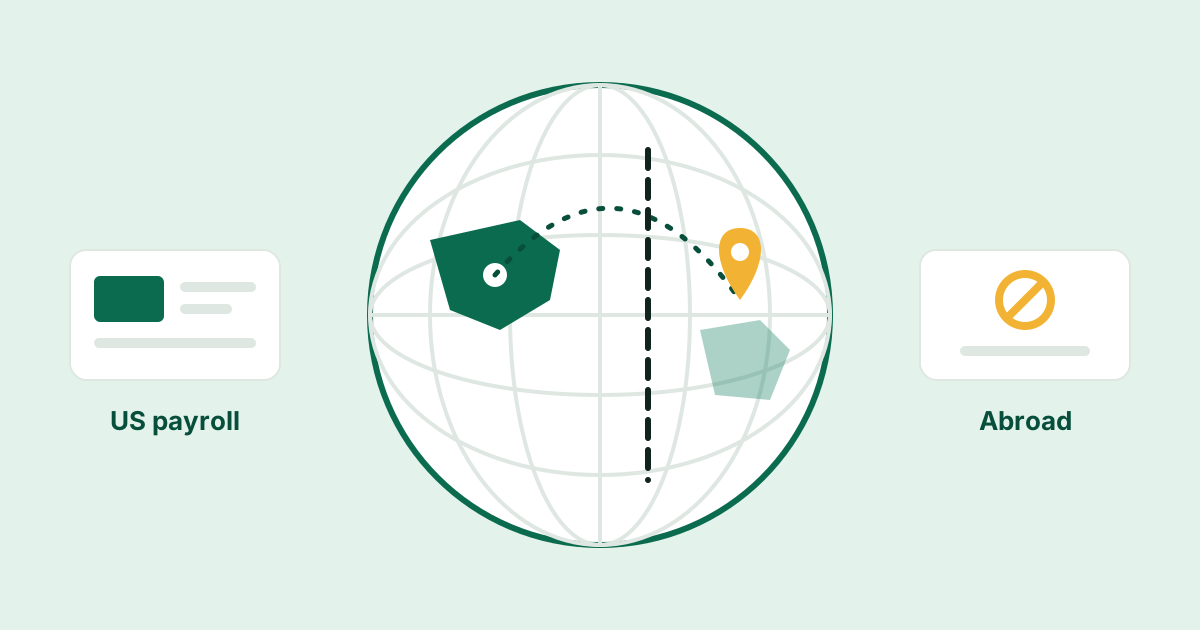
"Remote" in a US job posting almost always means remote inside the United States, and often inside a list of specific states. The reason is not distrust. An employee working from another country can create tax, payroll, immigration and data-security obligations for the employer in that country, and most companies are not set up to carry them. If you want to work from abroad, you need to understand what you are asking the company to take on, and ask before you book the flight.
What a posting means by "remote (US)"
Employers already limit remote hiring to states where they are registered for payroll, as explained in why remote jobs are limited to certain states. Another country is the same problem, larger. Read postings and offer letters for phrases like these:
- "Remote, United States" or "must reside in the US"
- "must be authorized to work in the United States" (this is about your status, not your location, but the two usually appear together)
- "work must be performed in the United States", which is common in roles that touch government, health or financial data
If a posting is silent, assume US only. The employee handbook or the remote-work policy usually states it outright, often with a limit on the number of days per year you may work from another country.
The employer's side: four problems
Corporate tax exposure
When an employee regularly works from another country, that country may treat the employer as having a taxable presence there, often called a permanent establishment. Whether it does depends on local law, on any tax treaty with the United States, and on what the employee does: someone who negotiates and signs contracts is a much bigger risk than someone who writes internal code. The company's finance team cannot evaluate this casually, and the downside is a corporate tax filing obligation in a country where the company has no entity.
Payroll, social insurance and employment law
Many countries expect an employer to register, withhold local income tax and pay social contributions for people who work on their soil. Local employment law can also attach to the employee after a period of time, bringing rules on notice periods, paid leave and termination that differ sharply from at-will employment in the United States. A US payroll system that knows fifty states does not know any of this.
Immigration
A tourist entry generally does not carry the right to work, and in many countries that includes remote work for a foreign employer. Some countries now offer remote-worker or "digital nomad" visas with their own income thresholds and tax consequences; the rules vary widely and change often. An employer that knowingly lets you work somewhere without the right status is taking on risk it gains nothing from.
Data security and export controls
Security teams restrict logins by country for practical reasons: customer contracts that promise data stays in the United States, health and financial data rules, and US export controls. The Bureau of Industry and Security treats the release of controlled technology or source code to a foreign person as an export even when it happens inside the United States, a concept called a deemed export; carrying or accessing that kind of technology in another country raises the same questions more directly. If you work as a security engineer or on anything defense-adjacent, expect a hard no.
This is also why working abroad quietly through a VPN is a bad idea. Company devices report location in several ways, sign-in systems flag impossible travel, and what would have been a policy question becomes a trust and termination question.
Your side: US taxes follow you
If you are a US citizen or resident alien, moving abroad does not end your US tax obligations. The IRS states it plainly: you are taxed on your worldwide income wherever you live.
The foreign earned income exclusion
The main relief is the foreign earned income exclusion. Its key rules:
- You must have foreign earned income, and your tax home must be in a foreign country. The IRS says you do not have a foreign tax home if your abode remains in the United States.
- You must meet one of two tests: the bona fide residence test (resident of a foreign country for an uninterrupted period that includes an entire tax year) or the physical presence test (physically present in a foreign country or countries for at least 330 full days during any period of 12 consecutive months).
- The maximum exclusion is adjusted every year. The IRS lists $130,000 for tax year 2025 and $132,900 for tax year 2026 per qualifying person.
- The exclusion is claimed on a filed return. It reduces regular income tax; for self-employed people it does not reduce self-employment tax.
Three months in Lisbon does not come close to either test. For a short stay, your salary is simply taxed by the United States as usual, and possibly by the other country as well.
Social Security and Medicare
Wages for work performed outside the United States are generally still subject to US Social Security and Medicare taxes when the employer is an American employer, which includes a corporation organized under US federal or state law. The other country may want its own social contributions for the same work. The United States has totalization agreements with a number of countries to prevent paying twice; where one applies, a certificate of coverage from one country's social security agency is the document that proves the exemption in the other. Where none exists, double contributions are possible.
State taxes do not switch off either
Leaving the country does not automatically end tax residency in the state you left. States look at domicile: where your home, driver's license, voter registration and family are. Some are persistent about former residents who keep those ties. The mechanics are in the post on remote work and state taxes, and this is a point to confirm with your state's revenue department or a tax professional before you go.
The host country
The country you are sitting in may tax your wages from the first day or after a threshold, commonly counted in days per year. Tax treaties and foreign tax credits can prevent the same income being taxed twice, but they do not remove the filing work. Nothing in this post replaces advice from a cross-border tax professional who knows both countries.
Arrangements employers do approve
| Arrangement | How it works | Typical catch |
|---|---|---|
| Short "work from anywhere" window | Policy allows a set number of days abroad per year | Country list, pre-approval, no client-facing work |
| Employer of record | A third party legally employs you in the country and bills your company | Cost to the employer; local contract, local benefits; US equity and 401(k) may not carry over |
| Local entity transfer | Company has a subsidiary there and moves you onto its payroll | Local pay band, local terms |
| Contractor conversion | You invoice the company as an independent contractor | Loses employee benefits and protections; misclassification risk in both countries |
The first is by far the most common. A 300-person software company might allow 20 or 30 working days abroad per year, in approved countries, with a ticket to HR and IT beforehand. That is enough for a long family visit, not for a relocation.
Be skeptical of the contractor route. It looks simple, but it moves every cost onto you, and many countries test whether a "contractor" who works full time for one client is really an employee. The trade-offs are covered in W-2 employee or 1099 contractor.
How to ask
Ask early, in writing, and with specifics. Before accepting an offer, the right question is: "What is your policy on working temporarily from outside the United States?" It belongs in the same conversation as the other terms in negotiating a remote job offer.
If you already work there, send HR a short request that covers:
- Country, exact dates and total working days
- Your citizenship or immigration status in that country
- The hours you will keep relative to the team
- What data and systems your role touches
- Whether you will meet customers or sign anything while there
Managers are often sympathetic and cannot approve this on their own. A verbal yes from your manager is not approval; get the answer from whoever owns the policy.
Practical gaps people forget
- Health insurance. US employer plans are built around US provider networks, and many cover only emergencies abroad, if that. Check the plan document and buy travel medical cover if needed.
- Equipment. Company laptops may not be allowed across certain borders, and some countries restrict encrypted devices.
- Banking and benefits. Payroll will keep paying into a US account and withholding for your US state of record. Changing that requires the company to agree to everything above.
- Hours. A nine-hour offset from your team is a cost someone pays every day. See time zones and core hours.
What to do next
If working abroad for part of the year matters to you, make it a search criterion rather than a surprise. Look for employers that publish a work-from-anywhere policy or have entities in the country you care about, read the location line of each posting on the employer's own career page, and ask the policy question before the offer stage. If you are a US citizen planning a longer stay, read the IRS pages linked above and talk to a tax professional before you leave, not after your first year abroad. You can browse current remote jobs and check each employer's stated location requirements directly at the source.