Time Zones and Core Hours: Reading the Schedule Behind a Remote Job
Remote does not mean any hours you like. This post explains what core hours, overlap requirements and time zone lines in a job posting mean for your actual day, and which questions to ask before you accept.

Steven Schulz
· 7 min read
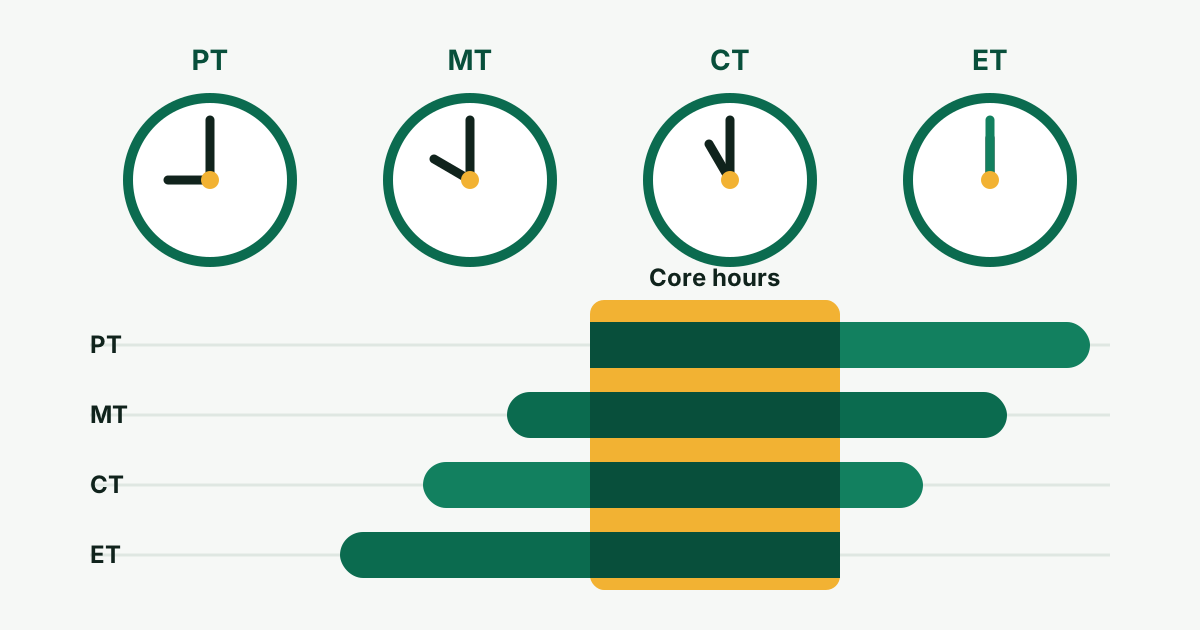
A remote job removes the commute, not the schedule. Most remote employers expect you to be reachable during a defined window, and that window is set in someone else's time zone more often than in yours. One line in a posting, "core hours 11–3 ET" or "must work Pacific hours," decides when your day starts, when it ends and whether the job fits the rest of your life. It is worth reading that line as carefully as the pay range.
The vocabulary
Postings use a handful of terms, and they are not interchangeable.
- Core hours. A fixed block in which everyone is expected to be online and available for meetings, for example 11 a.m. to 3 p.m. Eastern. Outside the block you arrange your remaining hours yourself.
- Overlap. A softer version: "at least four hours of overlap with the team in Central time." You pick the hours as long as enough of them coincide.
- Working a zone's hours. "Eastern time hours" or "must work PST business hours" means a full conventional workday in that zone, wherever you live.
- Shift. A defined start and end, common in customer support, operations and clinical roles. Often comes with weekend or evening rotations.
- Follow-the-sun. Work is handed from one region to the next so that someone is always on. For you this usually means a normal local day with a structured handoff at each end.
- On-call. Outside normal hours you can be paged for emergencies during a rotation, typically a week at a time.
- Async-first. The company keeps required real-time hours small and relies on written communication. It rarely means zero meetings.
When a posting says only "flexible schedule," assume nothing. Flexible can mean choosing your own hours, or it can mean the employer's hours flex and you follow. The post on what remote, hybrid and distributed mean in postings covers how loosely these labels are used.
The US time zone math
The contiguous United States spans four zones, each one hour apart, so the East and West coasts differ by three hours. Alaska is one hour behind Pacific. Hawaii is two hours behind Pacific in winter and three in summer, because Hawaii does not observe daylight saving time.
| When it is noon Eastern | Local time |
|---|---|
| Central (Chicago, Dallas) | 11 a.m. |
| Mountain (Denver, Salt Lake City) | 10 a.m. |
| Pacific (Seattle, Los Angeles) | 9 a.m. |
| Alaska (Anchorage) | 8 a.m. |
| Hawaii (Honolulu) | 7 a.m. in winter, 6 a.m. in summer |
Two wrinkles catch people out:
- Arizona. Most of the state stays on Mountain Standard Time all year. In summer its clocks match Pacific time; in winter they match Mountain. The Navajo Nation, in the state's northeast, does observe daylight saving time. A meeting that sits at 9 a.m. for a colleague in Phoenix in January sits at 8 a.m. in July if it was scheduled in Eastern time.
- Abbreviations. People write "EST" all year when they mean Eastern time. Strictly, EST is winter and EDT is summer. In a posting, read "EST" as "Eastern, whatever the clock says today." In your own writing, use "ET," "CT," "MT" and "PT" and avoid the problem.
If the team includes people abroad, check when their clocks change. Europe moves on different dates than the United States, so for a few weeks each spring and fall a recurring meeting shifts by an hour for one side.
What a schedule line means for your day
Translate every requirement into your local clock before you apply. Four examples.
Core hours 11 a.m.–3 p.m. Eastern. In Portland that is 8 a.m. to 11 a.m. local. Your meetings cluster in the morning and your afternoons are quiet, which many people on the West Coast like. In Boston the same block sits in the middle of the day and splits it in two.
"Must work Eastern business hours," living in Pacific. A 9-to-5 Eastern day is 6 a.m. to 2 p.m. in Los Angeles. Some people would not trade it: done by mid-afternoon, free for school pickup. Others find a daily 6 a.m. start wears them down by the second winter. Be honest about which one you are, because the schedule does not change after the offer.
"Must work Pacific hours," living in Eastern. A 9-to-5 Pacific day is noon to 8 p.m. in Atlanta. Mornings are yours; dinners and evening activities are not. This direction tends to be harder for people with families and easier for night owls.
A four-hour overlap with a team in Central Europe. Central Europe is usually six hours ahead of Eastern. Their afternoon, 2 p.m. to 6 p.m., is 8 a.m. to noon Eastern, which is comfortable. From the West Coast, the same window is 5 a.m. to 9 a.m. That is why postings with European teams often restrict hiring to the Eastern and Central zones.
Time zone limits are a different thing from state limits. A posting restricted to certain states usually reflects tax registration and employment law, not the clock; see why remote jobs are limited to certain states. And a team in a compatible zone abroad does not mean you may work from there, which the post on working from abroad for a US employer explains.
Roles where the schedule is the job
In some functions the hours are not a team preference but the product.
- Customer support. Coverage is sold to customers as a promise, so support roles run on shifts, including evenings, weekends and holidays at many companies. Postings in customer support generally state the shift; if one does not, ask before the first interview.
- Sales. Your hours follow your territory. An account executive living in New York with accounts on the West Coast takes calls into the early evening. The territory matters more than the company's headquarters.
- Reliability and security engineering. A site reliability engineer usually carries a pager on rotation. The questions that matter are how often, how many pages per shift, and whether on-call is compensated.
- Clinical and licensed roles. Telehealth schedules follow patient demand and the states you are licensed in, with evening blocks common.
In engineering, product and design roles at async-leaning companies, the required window is typically shorter, and the skill that substitutes for shared hours is clear writing. That is the subject of the post on asynchronous communication.
Hourly roles and off-hours work
If the job is hourly or otherwise non-exempt, time spent working outside your shift is still work time. A quick reply to a message at 9 p.m. is small, but a habit of them adds up to hours, and those hours are supposed to be recorded and paid. Ask how time outside the scheduled shift is tracked and approved. For salaried exempt roles there is no such accounting, which makes the stated expectations and the team's real habits more important, not less.
Questions to ask before you accept
A posting gives you the headline. The interview is where you get the details. Ask the recruiter or hiring manager:
- What are the required hours, in which zone, and are they written down anywhere? A policy beats a manager's preference.
- Where is the team located? The official core hours matter less than where your manager and closest colleagues sit.
- When are the recurring meetings? Ask for the actual times of the standup, the weekly team meeting and any all-hands. One standing meeting at 7 a.m. your time defines every morning.
- How often do meetings fall outside core hours, and are they recorded?
- Is there on-call or weekend work? How often, and how is it compensated?
- What response time is expected for messages outside my working hours?
- What happens if I move to another time zone later? Some employers adjust nothing; some require approval; some tie it to pay zones.
Making a mismatch workable
If you take a job whose hours are offset from your local day, a few habits keep it sustainable:
- Set a fixed start and stop and put them in your calendar and profile. An offset schedule tempts you to work the team's hours and your local ones.
- Protect the quiet end. If your mornings or late afternoons fall outside the team's day, use them for focused work, not for catching up on messages.
- Write every time with its zone. "3 p.m. ET" in every message and invitation. Let the calendar do the conversion and check it after each clock change.
- Rotate the pain. If a meeting is always early for the West Coast or late for the East, propose alternating. Reasonable teams agree.
- Revisit after three months. If a 6 a.m. start is costing you sleep, raise it early. The patterns behind lasting fatigue are covered in the post on remote work burnout and boundaries.
What to do next
Before you send your next application, convert the posting's schedule into your own clock and write down your start time, your end time and your earliest likely meeting. If the posting gives no hours at all, add the question to your notes for the first call. Then decide your own limits in advance: the earliest start and latest finish you would accept for the right job, and for how long.
When you browse open remote jobs, read the location and schedule lines first. A role that fits your day is worth more than a slightly better one that takes your mornings or your evenings for years.