Remote Work Burnout: How to Set Boundaries That Actually Hold
Remote burnout rarely comes from one bad week; it comes from a workday with no edges. This post shows how to spot it early and build boundaries around hours, notifications and workload that survive a busy quarter.

Steven Schulz
· 7 min read
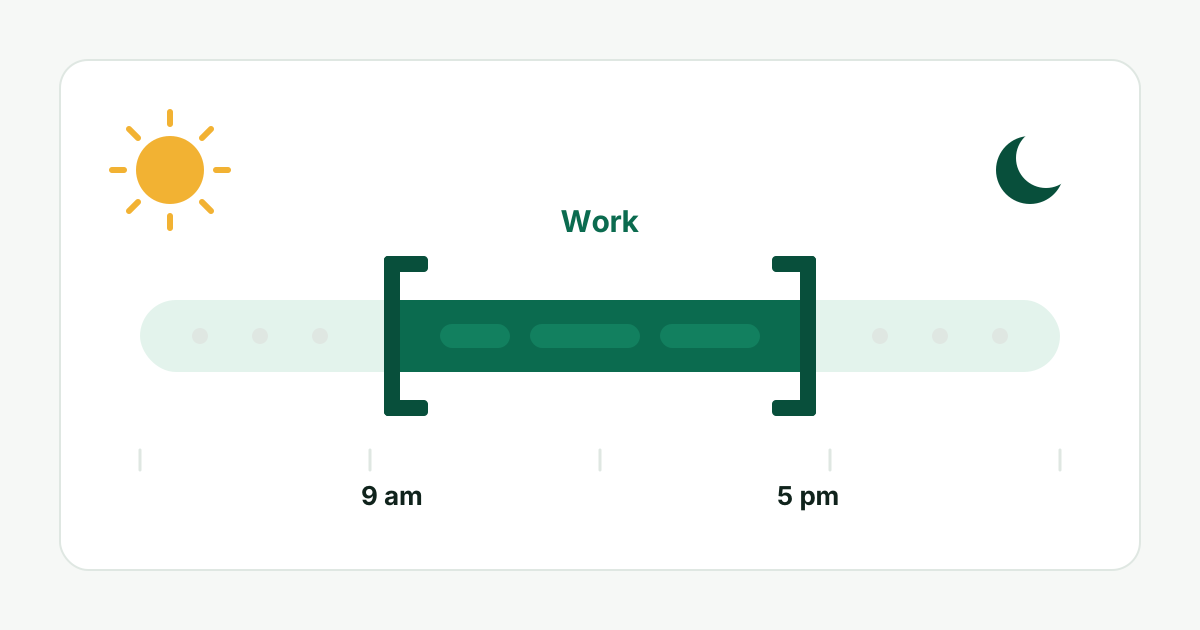
Burnout in a remote job is mostly a structural problem, not a character flaw. The office used to supply the edges of the day for free: a commute, a lunch crowd, a building that emptied out. At home you have to build those edges yourself, and the boundaries that hold are the ones built into your calendar, your tools and your agreements with other people, not the ones that depend on willpower at 7 p.m.
What burnout is, and what it is not
The World Health Organization describes burnout in ICD-11 as an occupational phenomenon, not a medical condition: a syndrome resulting from chronic workplace stress that has not been successfully managed. Its definition names three dimensions:
- feelings of energy depletion or exhaustion
- increased mental distance from your job, or negativity and cynicism about it
- reduced professional efficacy
That list is useful because it separates burnout from an ordinary hard stretch. A launch week leaves you tired; a weekend fixes it. Burnout is when rest stops working, when you start to resent colleagues you used to like, and when tasks that took an hour now take an afternoon.
It is also not the same as depression or anxiety, although they can overlap. If the heaviness follows you into parts of life that have nothing to do with work, or you are not sleeping or eating normally, talk to a doctor or a licensed therapist. Many employers offer an employee assistance program with a few confidential sessions at no cost.
Why remote work makes it easier to miss
Remote work removes friction, and some of that friction was protective.
The day has no natural end. Nobody stands up and puts a coat on. The laptop is on the kitchen table, so a quick look at a message after dinner becomes forty minutes.
Presence gets replaced by responsiveness. In an office, people can see that you are working. At home, the only visible signal is how fast you answer. Many remote workers respond by being reachable all the time, which fragments the day and pushes the real work into the evening.
Time zones stretch the window. If you are on Eastern time with a team that runs to the Pacific, there is a meeting-shaped reason to be online from 8 a.m. to 8 p.m. No single request is unreasonable. The sum is.
Nobody sees you fade. A manager who sits near you notices when you go quiet. A manager who sees you in two video calls a week does not. In a remote team you often have to be the one who raises the flag.
Early signs worth taking seriously
Burnout builds slowly, and the early stage is the cheapest time to act. Watch for patterns that last longer than two or three weeks:
- You open the laptop "just to check" on evenings and weekends, and feel uneasy when you do not.
- Small messages produce a disproportionate spike of irritation or dread.
- You have stopped taking a real lunch, or you eat it at the keyboard on mute.
- Deep work keeps sliding to after hours because the day is all meetings and replies.
- You have not taken more than a day or two off in six months.
- You are doing the visible parts of the job and quietly dropping the parts nobody checks.
One of these is a busy month. Three or four together are a signal to change something structural rather than wait for a quieter quarter that never arrives.
Boundaries that hold are built into the system
A boundary that depends on you deciding, again, every evening, will lose to the next urgent message. Move the decision out of the moment.
Give the day a hard stop
Pick an end time and attach it to something outside work that has its own deadline: a school pickup, a gym class, a dog that needs walking, dinner you cook with someone. An appointment is far harder to slide past than an intention.
Then add a short shutdown routine. Five minutes is enough: write down where you stopped and the first task for tomorrow, check the calendar for the morning, close every work tab. The written note matters. It is what lets your head stop rehearsing the open items at 10 p.m.
Separate work from home, physically where you can
A separate room with a door is the ideal and not everyone has one. The cheaper versions still work: a desk that is only for work, a laptop that goes into a drawer or a bag at the end of the day, a separate browser profile for work accounts. If your employer offers a home office stipend, this is where to spend it.
Take work off your phone, or put it on a schedule
This is the single highest-impact change for most people. If your role has no on-call duty, you do not need chat and email on your personal phone at all. If you do need them, use the scheduling features every major chat and mail app now has:
- notifications paused automatically outside your working hours
- a status that says when you are back, so nobody has to guess
- a clear, separate channel for real emergencies, such as a phone call or the paging tool
That last point is what makes the first two acceptable to a team. People stop pinging you at night when they trust that a real emergency has a route that works.
Publish your hours and your response times
Put your working hours in your calendar and your chat profile. Then say out loud what people can expect: "I check messages at the start of the day, around noon and before I sign off; for anything that cannot wait three hours, call me." Writing messages that do not need an instant answer is a skill of its own, and asynchronous communication is what remote employers screen for anyway.
If the pressure comes from spanning several zones, the fix is usually an explicit overlap window rather than one person stretching both ends of the day. The post on time zones and core hours explains how to read and negotiate that.
When the workload is the problem
Boundaries around time do not help if the job is simply sized for one and a half people. In that case the conversation with your manager is the boundary. Go in with facts, not feelings:
- List everything you own, with a rough weekly hour estimate for each item.
- Mark what is growing and what was added in the last quarter.
- Propose a choice: "With the current list, I can deliver A and B this month. C slips to next month unless something else comes off. Which would you rather?"
This framing works because it treats your manager as someone who sets priorities, which is their job, rather than someone you are complaining to. It also protects you later: a written, agreed priority list is hard to reinterpret as underperformance. The remote employees who advance are the ones whose commitments are reliable, and you cannot be reliable at 130 percent load. There is more on that in getting promoted as a remote employee.
| Situation | Weak response | Response that holds |
|---|---|---|
| Late-evening messages | Answer quickly "this once" | Scheduled quiet hours plus a real emergency route |
| Meetings fill the whole day | Do deep work at night | Two blocked focus mornings, declared to the team |
| New project lands on a full plate | Say yes and hope | Ask which current item moves |
| No time off in months | Wait for a calm period | Book the dates now, arrange cover |
Take time off properly
A long weekend during which you read every message is not time off. Before you leave, write a short handover: what is in progress, who decides what in your absence, where the documents are. Set an out-of-office that names a person, not just a return date.
If your company has an "unlimited" leave policy, treat it as a policy with an unstated number and find that number: ask teammates how much they took last year. Then plan your year around it in January, because unplanned leave is the kind that does not get taken.
When the job itself will not change
Sometimes the boundaries are fine and the employer is the problem: a team where every week is an emergency, a manager who rewards midnight replies, a headcount that will never match the roadmap. You are allowed to conclude that the fix is a different job.
If you start looking, check for the pattern before you sign up for it again. Read how a posting describes hours and on-call duty, ask in interviews how the team handles out-of-hours requests and how much leave people actually take, and research the company for signs of chronic understaffing. The open remote jobs on this site link straight to the employer's own posting, which is where schedule and time-zone expectations are stated most plainly.
What to do this week
- Pick an end time for your workday and attach it to a fixed commitment.
- Turn on scheduled quiet hours in chat and mail, and tell your team how to reach you in a real emergency.
- Write your working hours into your calendar and profile.
- If your list is too long, draft the three-step priority conversation and put it on your manager's calendar.
- Book your next week off, with dates.
None of these requires permission, and each one still works in the busiest month of the year. If you are new in a role, set them up early; the habits you establish in your first 90 days are the ones your team will treat as normal.