Your First 90 Days in a Remote Job: A Plan That Works From Home
Nobody watches you settle in when you start remotely, so you have to make your progress visible yourself. This plan covers the week before you start, the first week, and what to learn, deliver and agree with your manager by days 30, 60 and 90.

Steven Schulz
· 7 min read
Starting a remote job is harder than starting in an office for one reason: nobody can see you. Your manager cannot tell whether you are stuck, your colleagues do not bump into you, and the unwritten rules stay unwritten unless you ask. The first 90 days go well when you replace all that passive visibility with deliberate habits: ask more than feels natural, write down what you learn, and deliver something small early.
Before day one
The week before you start is mostly paperwork, and it is worth doing promptly because delays here can push your start date or your first paycheck.
- Onboarding documents. Expect tax forms, direct deposit details, benefits enrollment and employment eligibility verification. The I-9 has deadlines tied to your first day; the process for remote hires is explained in background checks, I-9 verification and what happens after a remote offer.
- Equipment. Ask when the laptop ships and what else the company provides. If there is a stipend, find out whether you buy first and get reimbursed. Details are in home office setup and stipends.
- Benefits deadlines. Enrollment windows for health insurance and the 401(k) are often short. Note the dates; see benefits in a remote job.
- Day-one logistics. Ask your manager or recruiter what time you start, in which time zone, and what the first meeting is. Remote first days fail on small things like a missing login.
Test your camera, microphone and internet before the first call. Have a fallback, such as a phone hotspot, for the first week.
Week one: learn how the team actually works
Your goal in the first week is not output. It is a working map of the people, the tools and the habits.
Meet people on purpose
In an office, introductions happen on their own. Remotely, you schedule them. Ask your manager for a list of ten to fifteen people you should know, and book a 25-minute call with each over the first two or three weeks. Ask everyone the same few questions:
- What do you work on, and how does my role connect to it?
- What should I know that is not written down anywhere?
- Who else should I talk to?
- What would make me useful to you in the next few months?
Take notes. By the tenth conversation you will see which problems come up repeatedly, and those are the ones worth your attention.
Learn the communication norms
Every remote team has its own rules, and almost none of them write the rules down. Find out early:
- Which channel is for what: chat, email, the ticket system, documents.
- How fast a reply is expected in each.
- Which hours the team overlaps, and whether meetings are recorded.
- Whether decisions are made in meetings or in writing.
Watch what respected people on the team do and copy it. The posts on asynchronous communication and time zones and core hours explain the patterns you are likely to meet.
Keep an onboarding log
Open a document on day one and write down everything you learn: where things live, who owns what, terms you had to look up, steps that were missing from the instructions. It helps you, and at the end of the month you can turn it into improvements to the team's onboarding guide. That is often the easiest first contribution, and the next new hire will thank you.
Agree on expectations with your manager
The most common reason a remote start goes badly is a quiet mismatch between what the manager expects and what the new hire thinks is expected. In an office this gets corrected through small daily signals. Remotely it can run for weeks.
In your first or second one-on-one, ask directly:
- What does a good first 90 days look like to you?
- What should I have delivered by the end of month one and month three?
- How do you prefer updates: in writing, in our one-on-one, how often?
- How will I know if something is off track?
Write the answers into a short plan and send it back: "Here is what I understood. Tell me what I got wrong." You now have an agreed document to work from and to review together later.
Ask for a weekly one-on-one if one is not scheduled. For the first three months, weekly is the right rhythm; every two weeks is too slow for a new remote hire.
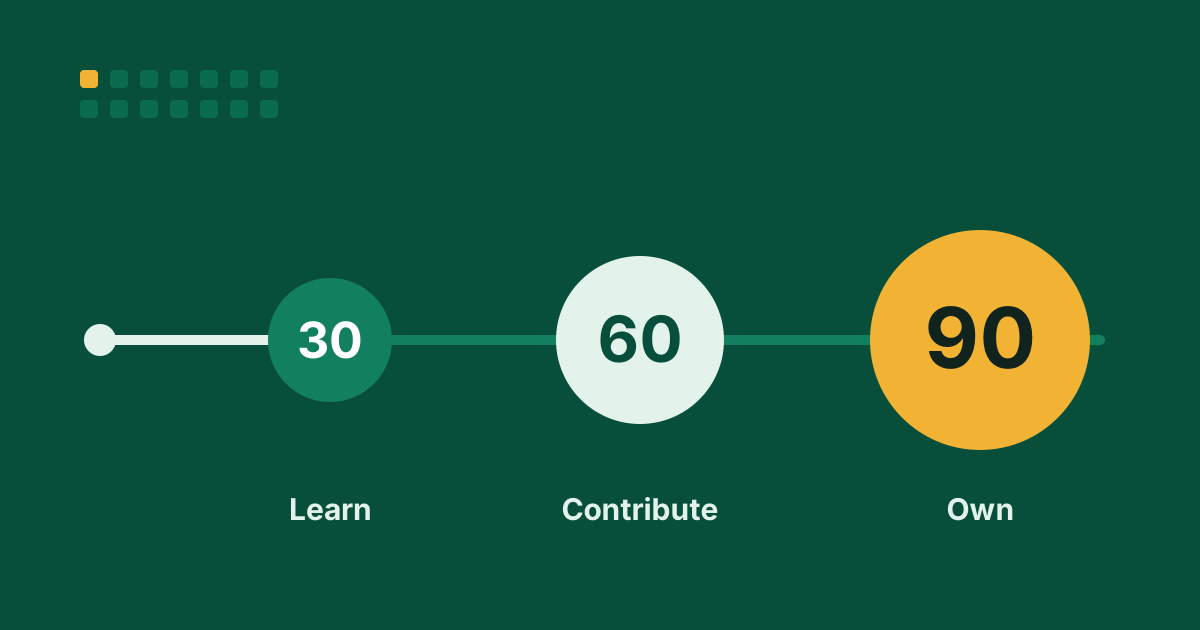
A 30-60-90 plan
The details depend on the role, but the shape is consistent.
| Period | Focus | You should be able to say |
|---|---|---|
| Days 1 to 30 | Learn | I know the people, tools, customers and current priorities, and I have shipped one small thing |
| Days 31 to 60 | Contribute | I own a piece of regular work and handle it without step-by-step help |
| Days 61 to 90 | Own | I am responsible for a result, and I have proposed one improvement of my own |
Days 1 to 30: learn, and ship one small thing
Read the documentation, shadow calls, and work through the product or the codebase. Alongside that, deliver something small and complete within the first two or three weeks: a fixed bug, a cleaned-up report, a handled customer account, a corrected help page. Size does not matter. What matters is that the team sees you take something from start to finish.
Hold your opinions about what should change. You will notice things that look wrong. Write them down, and ask why they are the way they are before proposing anything. Some have reasons you cannot see yet.
Days 31 to 60: take on regular work
By now you should be taking tasks from the normal queue and completing them with less guidance. This is the time to ask for feedback explicitly. Ask your manager: "What is one thing I should do differently?" A general "how am I doing" gets a general answer.
Check your plan against reality. If the priorities have shifted, update the document with your manager.
Days 61 to 90: own a result
Take responsibility for something with a visible outcome: a project, a set of accounts, a part of the system. Bring one well-founded proposal from your list of observations, with the reasoning written out. At around day 90, ask for a review conversation even if the company does not schedule one. Cover what went well, what to change, and what the next six months should look like. This conversation is also the foundation for everything in getting promoted as a remote employee.
Make your work visible without being noisy
People worry that reporting their own progress looks like self-promotion. On a remote team it is simply information others need. A manager with eight reports in four time zones cannot find out what you did unless you say so.
A few habits are enough:
- A weekly written update. Three short parts: what I finished, what I am working on, where I need help. Send it to your manager at the same time each week.
- Work in shared spaces. Ask questions in the team channel instead of private messages where it is reasonable. Others learn from the answer, and people see what you are working on.
- Close loops. When someone helps you, tell them how it turned out. When you finish a task, say so where it was assigned.
Ask early, ask well
New remote hires tend to stay stuck too long because asking feels like an interruption. A reasonable rule: try on your own for 30 minutes, then ask. A good question shows your work: "I am trying to do X. I tried A and B and got this error. Where should I look next?" That takes a colleague two minutes to answer and shows you made an effort.
Asking many questions in the first month is expected. Asking the same questions in month four is not, which is another reason for the log.
Mistakes to avoid
- Waiting to be told. If your calendar is empty in week one, fill it with introductions and reading, and tell your manager what you are doing.
- Going silent. Long quiet stretches read as trouble, even when you are working well.
- Proving yourself with hours. Being online late every night in the first month sets an expectation you will regret. Set sustainable hours from the start; see remote work burnout: boundaries that hold.
- Criticizing before understanding. "At my last company we did it this way" lands badly in the first weeks.
- Skipping the social part. Join the optional calls for a while. Trust is built in small talk, and remote teams have very little of it.
What to do next
If you have not started yet, write your questions for the first one-on-one and set up the onboarding log. If you are already in, check where you stand against the table above, send your manager a short written plan, and book the introductions you have been putting off. At day 90, ask for the review conversation and agree on the next goals in writing.