Background Checks, Form I-9 and What Happens After a Remote Offer
Between a remote offer and your first day sit a background check and Form I-9. This post explains what employers may check, your rights under federal law, how remote document verification works and when it is safe to resign.

Steven Schulz
· 7 min read
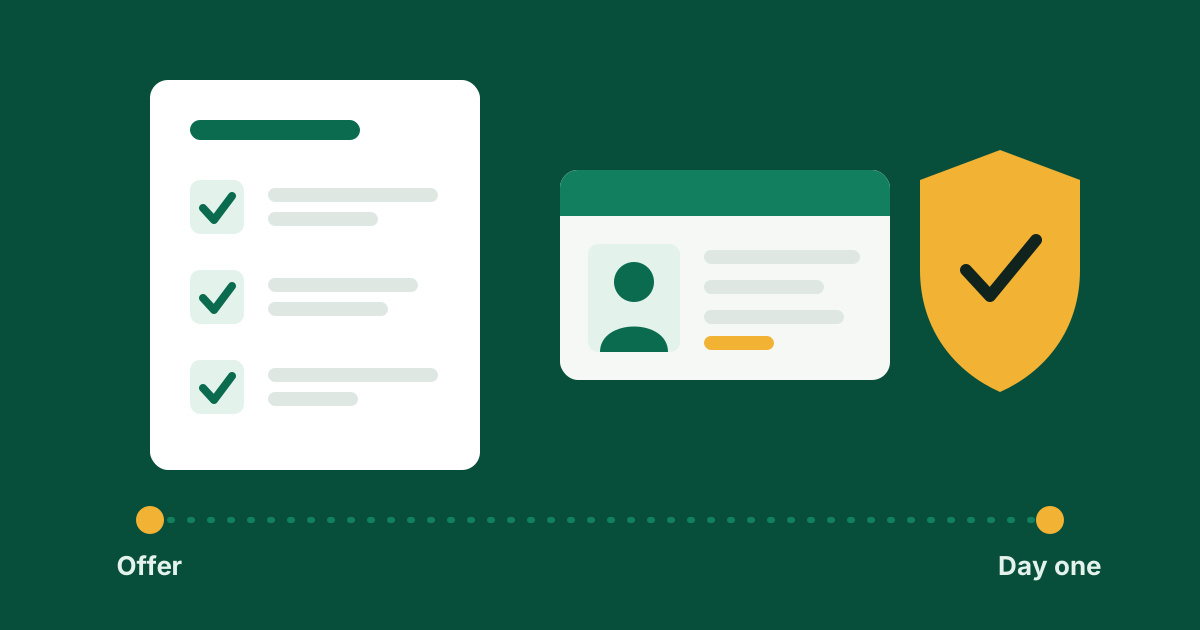
A remote job offer is usually conditional: it depends on a background check and on proof that you are allowed to work in the United States. Both steps are governed by federal rules that give you specific rights and deadlines, and both run a little differently when nobody meets you in person. Knowing the sequence tells you what to have ready, what an employer may not do, and when it is safe to give notice at your current job.
The sequence after you say yes
The order is fairly consistent across employers.
| Step | Who acts | What to expect |
|---|---|---|
| Conditional offer | Employer | Offer letter naming the contingencies |
| Disclosure and authorization | You | A separate form permitting a background report |
| Background check | Screening company | Often several days; longer if courts or past employers are slow |
| Form I-9, Section 1 | You | After accepting, no later than your first day |
| Form I-9, Section 2 | Employer or representative | Within 3 business days of your start date |
| E-Verify case | Employer, if enrolled | Usually resolved quickly; a mismatch gives you time to respond |
The practical rule: do not resign from your current job until the employer confirms in writing that the background check has cleared, or that the offer is no longer conditional on it.
What a background check covers
Employers buy these reports from screening companies. Depending on the role, a report may include:
- identity and Social Security number trace, with address history
- criminal records from county, state and federal courts
- verification of past employers, dates and titles
- verification of degrees and professional licenses
- driving records for jobs that involve driving
- credit history for some finance roles, where state law allows it
Remote employers also want to confirm that the person who interviewed is the person who starts, so expect identity checks, sometimes on video.
The most common problems are mundane. A previous employer has closed, a title in the HR system differs from the one on your resume, or your end date is off by a month. Fix these in advance: use the exact dates and official titles in the forms, and keep an offer letter, W-2 or pay stub for any employer that may be hard to reach.
Your rights under the Fair Credit Reporting Act
When an employer uses a screening company, the Fair Credit Reporting Act applies. The FTC's guidance for employers lays out the steps:
- Before the check. The employer must tell you in writing, in a notice that stands apart from the job application, that it may use a consumer report for employment decisions, and it must get your written permission.
- Before a negative decision. If the employer may reject you because of the report, it must first give you a copy of the report and "A Summary of Your Rights Under the Fair Credit Reporting Act". The point of this advance notice is to let you check the report for accuracy.
- After a negative decision. The employer must give you the name, address and phone number of the screening company, state that the company did not make the decision, and tell you that you can dispute inaccurate or incomplete information and request an additional free report from the company within 60 days.
You can refuse to authorize a check, but as the EEOC and FTC put it for applicants, the employer may then reject your application.
Federal law also limits how far back some information may go. Under 15 U.S.C. § 1681c, screening companies generally may not report arrests or most other adverse items older than seven years. Records of criminal convictions are excluded from that limit, and the limit does not apply at all to jobs with an annual salary of $75,000 or more. Several states set tighter limits.
If the report is wrong
If you receive a pre-adverse action notice:
- Read the report the same day and mark every error.
- Dispute it with the screening company in writing and attach proof, such as a court disposition or a letter from a former employer.
- Tell the employer immediately that you are disputing the report, and ask them to hold the decision until the reinvestigation finishes.
Criminal history and fair chance laws
Anti-discrimination law applies here too. The EEOC's position is that an employer must apply the same background standards to everyone regardless of race, national origin, sex, religion, disability, genetic information or age, and that a blanket policy excluding people with certain criminal records can be unlawful if it significantly disadvantages people of a particular race or national origin and is not job related and consistent with business necessity.
On top of that, many states and cities have "fair chance" or "ban the box" laws that control when an employer may ask. California's Fair Chance Act, for example, generally prohibits employers with five or more employees from asking about conviction history before making a job offer. For a remote job, which state's law applies can depend on where you live, so look at your own state's civil rights or labor agency.
If you have a record, do not volunteer it in the application unless asked, answer truthfully when asked, and prepare a short factual account: what happened, when, and what has changed since. An inaccurate answer on a form is usually a bigger problem than the record.
Form I-9: proving you can work in the United States
Every US employer must complete Form I-9 for every new hire, citizen or not. It has two parts.
Section 1 is yours. You fill it in and sign it no later than your first day of employment, and not before you have accepted the offer. Your Social Security number is required in Section 1 only if the employer participates in E-Verify.
Section 2 is the employer's. The employer or its authorized representative must examine your documents and complete Section 2 within 3 business days of your date of hire. You choose which documents to present: either one from List A, which proves both identity and work authorization (a US passport is the usual example), or one from List B for identity (such as a driver's license) together with one from List C for work authorization (such as an unrestricted Social Security card or a birth certificate). An employer should not demand a particular document. Originals are required and expired documents generally do not work, so check yours now.
How it works when you are remote
There are two routes.
- Authorized representative. The employer may designate any person to examine your original documents in person and complete Section 2 on its behalf: a notary, or a staffer at a local service the company contracts with. You cannot be the representative for your own form, and the employer stays liable for mistakes, which is why some companies insist on their own vendor.
- Remote examination. Employers that are in good standing in E-Verify may use a DHS-authorized alternative procedure: you send copies of your documents, front and back, then present the same documents in a live video call. The employer keeps the copies and marks the form accordingly. If an employer offers this at a hiring site, it must do so consistently, though it may limit the option to remote hires.
Either way, schedule the document check before your start date.
E-Verify mismatches
Employers enrolled in E-Verify submit your I-9 information to be compared against government records. Occasionally the result is a mismatch, also called a tentative nonconfirmation; a name change that never reached the Social Security Administration is a typical cause. According to E-Verify, a mismatch does not mean you are not authorized to work. Your employer must notify you, and you must tell the employer whether you will take action to resolve it by the 10th federal government working day after the result is issued.
Other contingencies you may see
- Drug screening. Less common for desk jobs than it once was, still standard in healthcare, transportation and safety-sensitive work. State laws on testing, and on cannabis in particular, vary a great deal.
- License verification. Clinical roles such as nurse practitioner or licensed clinical social worker involve license and credential checks in each state where you will see patients, which can take weeks.
- Residence confirmation. Because payroll depends on your state, employers confirm where you will work. The background is in why remote jobs are limited to certain states.
Scam check
Everything in this post happens after a real offer from a real employer. A "recruiter" who wants your Social Security number, passport scan or bank details before any interview, or who asks you to pay for a background check or equipment, is not following a hiring process. The FTC is blunt that honest employers never ask you to pay to get a job. More warning signs are in remote job scams: the red flags, and applying through the employer's own career page, which is where every listing on our job pages leads, removes most of the risk.
What to do next
Before your next offer arrives: check that your passport or driver's license is unexpired and that you can find your Social Security card or birth certificate; reconcile the dates and titles on your resume with what past employers will confirm; and if you expect something to appear in a check, prepare your explanation and documents. When the offer comes, ask which contingencies apply and how the I-9 will be handled remotely, and hold your resignation until the check has cleared. After that, the work shifts to your first 90 days.