Why 'Remote' Jobs Are Limited to Certain States
A remote employee turns the employer into a local employer in that employee's state, with payroll registrations, insurance and state labor law attached. This post explains what each obligation is and what a state list means for you as an applicant.

Steven Schulz
· 7 min read
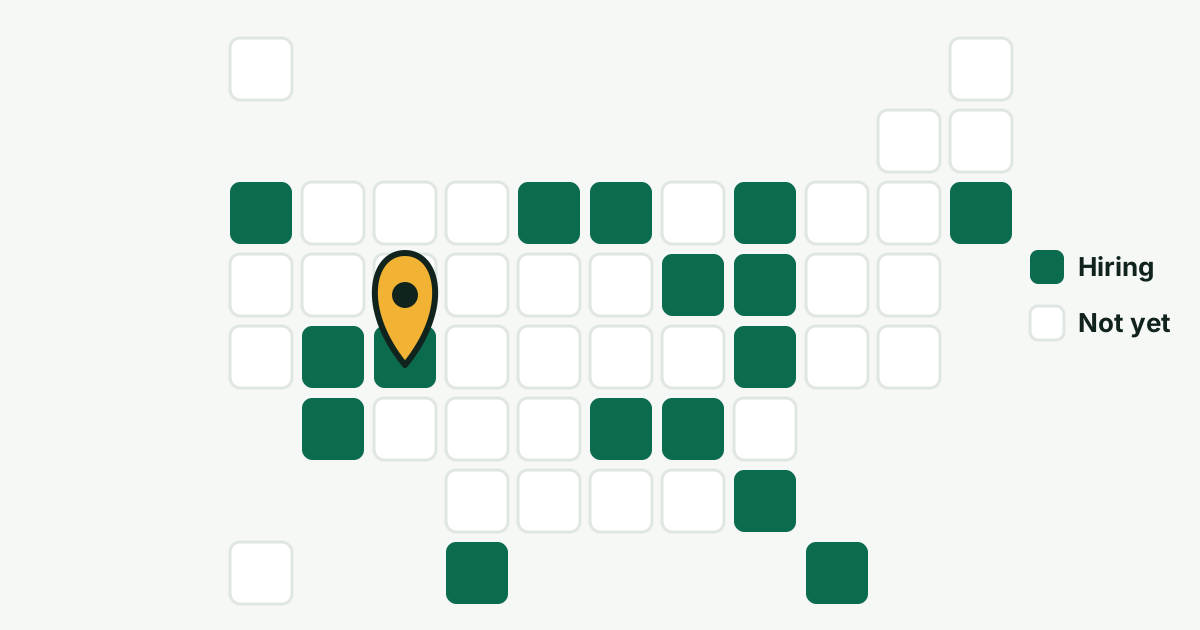
When a posting says "Remote, US" and then lists eleven states, the employer is not being arbitrary. Employment in the United States is regulated mostly state by state, and the rules that apply are generally those of the state where the employee does the work. One remote hire in a new state makes the company an employer there, with accounts to open, insurance to buy and a second rulebook to follow. Many companies decide that is worth doing in some states and not in others.
One employee makes the company a local employer
Take a 200-person software company based in Texas that hires a support specialist who lives and works in Oregon. From the first paycheck, that employee's wages are Oregon wages. Oregon's income tax withholding applies, Oregon's unemployment insurance system expects contributions, Oregon's workers' compensation rules apply to an injury in that home office, and Oregon's wage and hour law governs breaks, overtime and final pay.
None of this depends on the company having an office, a customer or a sign in Oregon. The employee's desk is enough. The same logic then repeats for every additional state, each with its own agencies, forms, deadlines and rates.
The registrations behind a single hire
Before the first payroll run in a new state, an employer typically has to deal with four things.
- State income tax withholding. In states with a wage income tax, the employer registers with the revenue department, withholds from each paycheck and files returns, often quarterly. A handful of states have no wage income tax, which removes this step but none of the others. The employee's side of this, including what happens when you live in one state and your employer sits in another, is covered in remote work and state taxes.
- Unemployment insurance. Every state runs its own unemployment insurance program, funded by employer taxes at rates set under state law. The US Department of Labor summarizes the system on its unemployment insurance tax page and notes that state laws differ from federal law, so employers must deal with each state workforce agency. For a fully remote employee, the state where the work is performed is normally the one that collects the tax and would pay the benefits.
- Workers' compensation. Coverage for private-sector employees is governed by state law and overseen by state boards; the Department of Labor's workers' compensation page simply refers private employees to their state. The employer's policy has to cover each state where it has staff, and a few states require buying coverage from a state-run fund instead of a private insurer.
- Registration to do business. Depending on the state, having an employee there can require the company to register with the secretary of state as an out-of-state entity, appoint a registered agent and file annual reports.
Each item is manageable. Multiplied by 30 or 40 states, with different portals and filing calendars, it becomes a standing workload for a payroll team.
State employment law travels with the worker
The registrations are the paperwork. The larger commitment is that the employee is protected by the labor law of the state where they work, and those laws vary widely. The Department of Labor keeps an overview of state labor laws, from minimum wages to meal and rest period rules and payday requirements. For an employer, each new state can change:
- Overtime and break rules. Some states calculate overtime by the day as well as by the week, or mandate paid rest periods that federal law does not.
- Who counts as exempt. Several states set a higher salary threshold for overtime-exempt status than the federal rule, so a salaried role that is exempt in one state may be owed overtime in another.
- Final pay and accrued vacation. Deadlines for the last paycheck range from immediate to the next regular payday, and states differ on whether unused vacation must be paid out.
- Paid leave programs. A growing number of states, among them California, New York, New Jersey, Washington and Massachusetts, run paid family and medical leave programs funded through payroll contributions. Many states and cities also require paid sick leave. See benefits in a remote job for how leave works across state lines.
- Expense reimbursement. Some states require employers to reimburse necessary work expenses, which matters for home internet and phones.
- Non-compete rules. A standard agreement that is enforceable in one state can be void in another.
A company with a single employee handbook written for its home state has to review all of this for every state it adds. That review is often what puts a state on the "not yet" list.
The pay transparency episode
One state-specific rule has had a visible effect on remote postings. Colorado's Equal Pay for Equal Work Act has required pay ranges in job postings since 2021. In the first months, some national employers responded by advertising remote jobs "open to all US locations except Colorado." The Colorado Department of Labor and Employment, which enforces the pay transparency rules, took the position in its guidance that a remote posting by a covered employer remains subject to the law even if it says Colorado applicants will not be accepted. As more states adopted similar laws, excluding one state stopped making sense. The current map is in pay transparency laws by state.
California illustrates how far these rules reach: its Labor Commissioner reads the state's posting law to require a pay scale whenever a position may ever be filled in California, in person or remotely.
Taxes on the business itself
Beyond payroll, an employee working in a state can give that state a claim on the company. Tax people call the connection nexus. Depending on the state and the company's activities, one resident employee can be enough to make the business liable to file corporate income or franchise tax returns there, or to collect sales tax on what it sells into the state.
This is why the decision about your application is sometimes made by the finance department. It is also why small companies tend to have short state lists and large companies, which already file everywhere, tend to hire in all or nearly all states.
Licensed professions add another layer
For some occupations the limit comes from professional licensing, not from the employer's payroll setup. Clinicians generally need to be licensed in the state where the patient is located, so a telehealth company hires therapists and nurse practitioners state by state according to where it has patients and where a candidate holds a license.
Interstate compacts ease this for some professions. Under the Nurse Licensure Compact, a nurse in a member state can hold one multistate license; 43 jurisdictions are part of it as of late 2026, which still leaves several large states outside. Postings for roles such as nurse practitioner or mental health therapist therefore name the license states explicitly, and that list is about your license as much as your address. Similar state-by-state rules apply to attorneys, insurance agents and some financial advisers.
How employers respond
Faced with all this, companies settle on one of a few approaches, and the posting usually reveals which.
| Approach | What you see in the posting | What it means for you |
|---|---|---|
| Fixed state list | "Remote in AZ, CO, FL, GA, NC, TX" | Outside the list, an application is usually rejected automatically |
| Exclusion list | "Remote, US, except AK, HI, CA" | The company is set up almost everywhere and avoids a few costly states |
| Case by case | "Remote, US" with no list | A new state may be possible for a strong candidate; ask early |
| Professional employer organization | Often nothing visible | A third party handles multi-state payroll, so the list is long |
| Contractor instead of employee | "1099" or "contract" | Avoids the registrations, shifts taxes and risk to you |
On the last row: classifying a worker as an independent contractor to sidestep state registration is only lawful if the work genuinely meets the tests for contractor status. What that status costs you is laid out in W-2 employee or 1099 contractor.
What a state list means for you
- Believe the list. Application forms often ask for your state, and a state outside the list can end the process without a human reading your resume.
- Do not borrow an address. Using a relative's address in an eligible state puts wrong information on tax and insurance records, and it is grounds for termination when it surfaces, which it does at the first tax form.
- Ask when the posting is silent. "Which states can you hire in for this role?" is a normal first-call question, as described in what job postings mean by remote.
- Tell your employer before you move. A move to a state where the company is not registered can force it to choose between setting up there and ending your employment. Raise it months ahead, in writing.
- Working from abroad is a separate question. A US state list never includes other countries; see working abroad for a US employer.
What to do next
Write down your state of residence and any state you might move to within two years, and check every posting against both before you apply. If you hold a professional license, list your license states next to them. For questions about your own tax or benefit position after a move, your state's revenue department and labor agency are the authoritative sources, and a tax professional is worth the fee when two states are involved.