Remote Job Benefits: Health Insurance, 401(k) and Leave Across State Lines
A benefits package is written once at headquarters, but a remote employee uses it in another state. This guide shows what changes with your address, from doctor networks and paid leave to COBRA, and what to ask before you accept.

Steven Schulz
· 7 min read
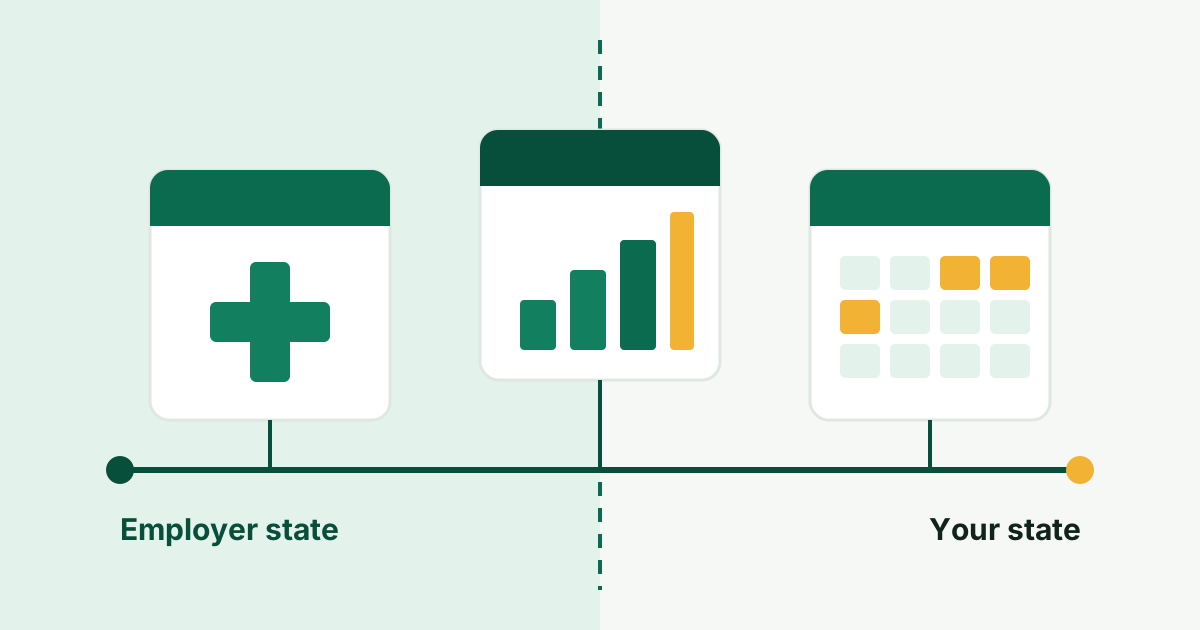
Benefits are the part of a remote offer that people compare least carefully, and the part where your home address matters most. The salary is the same number wherever you sit; the health plan, the leave you can take and the taxes that fund it are not. Before you accept a remote job based in another state, check three things: whether the health plan has doctors near you, what the 401(k) match is really worth after vesting, and which state's leave laws cover you.
What the law requires and what is only custom
It helps to separate the legal floor from what employers offer because the market expects it.
- Health insurance. No federal law forces every employer to offer a health plan. The Affordable Care Act puts a penalty on larger employers that do not. The IRS defines an applicable large employer as one with an average of at least 50 full-time employees, counting full-time equivalents, in the prior year. Such an employer has to offer affordable coverage that provides minimum value to at least 95 percent of its full-time employees and their dependents, or risk a payment. Full-time means an average of at least 30 hours a week.
- Retirement plan. No federal law requires a private employer to offer a 401(k), and none requires a match. Some states require employers without a plan to enroll workers in a state-run IRA program.
- Paid vacation. Federal law does not require it. Paid sick leave and paid family leave are required only by certain states and cities.
All of this applies to employees. If the role is a contract position, none of it does, which is the main cost covered in W-2 employee or 1099 contractor.
Health insurance: check the network before the premium
For a remote employee the first question is not the premium. It is whether the plan has in-network doctors and hospitals where you live.
Employer plans are built around provider networks, and many networks are regional. A 200-person software company in Denver may have chosen a plan with an excellent Colorado network and a thin one in Tennessee. If you live in Nashville, you may be paying for coverage that treats most of your local providers as out of network, with higher cost sharing or no coverage outside emergencies.
Employers that hire in many states usually handle this in one of three ways: a national PPO network, a separate plan for out-of-area employees, or different carriers by state. Small employers sometimes have not handled it at all. This is also one of the quieter reasons a posting lists only some states, as explained in why remote jobs are limited to certain states.
What to ask before you accept
Ask the recruiter for the benefits guide, a normal request at the offer stage. Then check:
- The carrier and network name, so you can search your own doctors in the carrier's directory.
- Whether the plan is an HMO, an EPO or a PPO. HMOs and EPOs generally do not pay for out-of-network care except in emergencies.
- What the employer pays toward the premium for you and for dependents.
- When coverage starts: on day one, or on the first of the month after hire.
- Whether there is a high-deductible plan with a health savings account, and whether the employer puts money into the account.
If the network does not reach you and the company will not fix it, treat that as a pay cut and raise it during negotiation.
The 401(k): match, vesting and the annual limit
A 401(k) follows federal rules, so it works the same in every state. The differences between employers lie in the match and the vesting schedule.
The match. A typical formula is a percentage of your contributions up to a share of salary, for example 50 percent of the first 6 percent you contribute. On a $100,000 salary that is $3,000 a year from the employer if you contribute at least $6,000.
Vesting. Your own contributions are always fully yours. Employer contributions can vest over time under a schedule set in the plan document. The IRS describes cliff schedules, where you own nothing until a set point and then everything, with three years as its example, and graded schedules that reach 100 percent after six years. If you expect to stay two years and the match vests on a three-year cliff, the match is worth nothing to you.
The limit. For 2026 the employee contribution limit is $24,500, with an additional $8,000 catch-up for people 50 and older and a higher catch-up of $11,250 for ages 60 to 63, according to the IRS announcement. The IRS adjusts these figures each fall, so check the 2027 amounts before you set your contribution for the new year.
Equity is a separate matter with its own rules, covered in equity compensation explained.
Leave: a federal floor and a patchwork of state programs
FMLA when you work from home
The federal Family and Medical Leave Act gives eligible employees up to 12 workweeks of unpaid, job-protected leave in a 12-month period, with group health coverage continued on the same terms. You are eligible after 12 months with the employer and 1,250 hours of service, and only if the employer has at least 50 employees within 75 miles of your worksite.
That last condition sounds fatal for someone working alone at home. It is not. The Department of Labor's Field Assistance Bulletin 2023-1 confirms that your home is not your worksite for this test. Your worksite is the office you report to or from which your assignments are made. If that office has 50 employees within 75 miles, you count as working there. At a fully distributed company with no real office, the answer depends on the facts, and it is worth asking HR directly.
State paid family and medical leave
Paid leave comes from states. As of late 2026, the Department of Labor's Women's Bureau counts thirteen states and the District of Columbia with paid family and medical leave laws: California, Colorado, Connecticut, Delaware, Maine, Maryland, Massachusetts, Minnesota, New Jersey, New York, Oregon, Rhode Island and Washington, plus D.C. Maryland's program has been delayed and is not paying benefits yet.
For a remote worker the rule of thumb is that coverage follows the state where you do the work, not where the employer is. Washington's program states it plainly on its page about localization and out-of-state employees: work done entirely in Washington is covered there even if the employee lives elsewhere, and a Washington resident working entirely in another state is not covered. So an Oregon resident working from home for a Texas company is generally in Oregon's program. Details differ by state, and the state agency is the place to confirm your case.
These programs are funded by payroll contributions, often shared between employer and employee, so you will see a line for it on your pay stub. State income tax withholding is covered in remote work and state taxes.
Sick leave and vacation
Paid sick leave laws work the same way: they are state or city laws and generally apply where you work. Vacation policy is the employer's to set. "Unlimited PTO" is a policy, not a balance, and in most cases there is nothing to pay out when you leave.
When you move
Moving to another state while keeping the job changes more than your tax withholding. The health plan network may no longer reach you, a different state's leave program may apply, and the employer may not be registered in the new state at all. Tell HR before you move, not after. A move outside the plan's service area can also open a special enrollment period for you to change plans.
When the job ends
Under COBRA, group health plans of private employers with at least 20 employees must let you keep your coverage after you leave. The Department of Labor's COBRA questions and answers for workers give the terms: 18 months after a termination or cut in hours, 60 days to elect, and a premium of the full cost of the plan plus 2 percent. That last point is the shock, because you now pay the share your employer used to pay. Many states have continuation laws for smaller employers; your state insurance department has the details.
Losing job-based coverage also qualifies you for a special enrollment period on the health insurance marketplace, generally for 60 days. Compare both before the deadline. The wider plan for that month is in laid off: severance, unemployment and a job search plan.
What to do next
Before you sign, get the benefits guide in writing and put the package into annual dollars: your premium share, the match you will actually vest in, and any paid leave. Search your own doctors in the plan's network and look up whether your state runs a paid leave program. When you browse remote jobs here, the listing shows the employer's published pay range and takes you to the employer's own page to apply; the benefits detail usually sits there too, so read it before the first interview. For a specific tax or coverage question, ask the state agency or a benefits professional, not the recruiter.