Pay Transparency Laws: Which States Require Salary Ranges in Job Postings
As of late 2026, fourteen states and Washington, DC require employers to put a pay range in job postings, and several of those laws reach remote jobs. This post lists them, explains the remote rules, and shows what to do when a range is missing.

Steven Schulz
· 7 min read
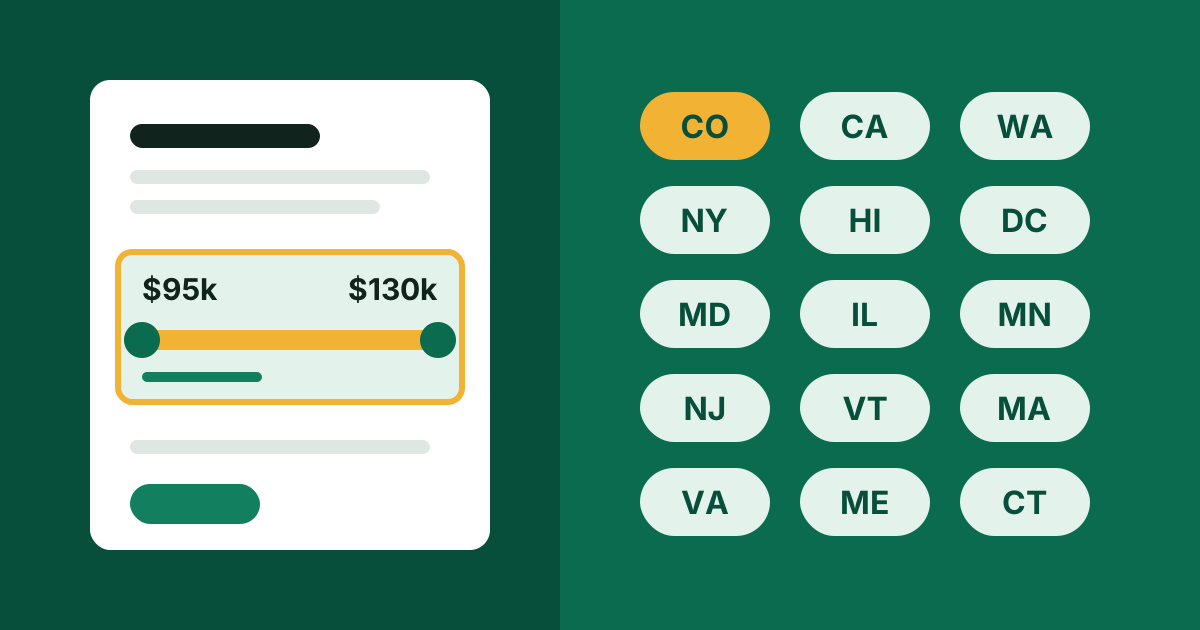
There is no general federal law that makes private employers publish pay in job ads. The requirement comes from states, and as of late 2026 more than a dozen states and the District of Columbia have one in force, with Delaware to follow in 2027. For remote job seekers the practical effect is larger than the count suggests, because several of these laws apply to any job that could be done from the state, and national employers increasingly post a range everywhere instead of maintaining two versions of each ad.
The states that require a pay range in the posting
The table shows jurisdictions where the range must appear in the job posting itself, in order of effective date. Employer size is the most common exemption.
| Jurisdiction | In force since | Covered employers |
|---|---|---|
| Colorado | January 2021 | Employers with at least one employee in Colorado |
| California | January 2023 | 15 or more employees |
| Washington | January 2023 | 15 or more employees |
| New York | September 17, 2023 | 4 or more employees |
| Hawaii | January 2024 | 50 or more employees |
| District of Columbia | June 30, 2024 | At least one employee in DC |
| Maryland | October 1, 2024 | All employers |
| Illinois | January 2025 | 15 or more employees |
| Minnesota | January 2025 | 30 or more employees |
| New Jersey | June 1, 2025 | 10 or more employees over 20 calendar weeks |
| Vermont | July 1, 2025 | 5 or more employees |
| Massachusetts | October 29, 2025 | 25 or more employees |
| Virginia † | July 1, 2026 | All employers |
| Maine † | July 29, 2026 | 10 or more employees |
| Connecticut † | October 1, 2026 | All employers |
| Delaware | September 26, 2027 | More than 25 employees |
† The three 2026 additions are new enough that agency guidance was not yet available when this was written. Those rows rest on published summaries of the new laws, not on the agencies' own pages; for Virginia, Maine and Connecticut, check the state labor department or attorney general before relying on the date or the threshold.
A few more notes on reading this. Legislatures amend these laws regularly, so confirm with the official source before relying on any table, including this one. Each state's agency publishes its own summary, for example Colorado, New York, Illinois and Massachusetts.
Disclosure on request, and local laws
Two states use a weaker model. Nevada and Rhode Island require employers to give the pay range to an applicant at a certain stage or on request, but not to print it in the ad. If you are interviewing with an employer in one of those states, ask; the law is on your side once you do.
Some cities and counties have their own ordinances. New York City had a posting rule before the state did, and Cleveland's ordinance, covering employers with 15 or more employees, took effect on October 27, 2025. Local rules matter mainly where the state has no law of its own, as in Ohio.
How these laws reach remote jobs
A state can only regulate jobs with some connection to it. The laws define that connection in three different ways, and the difference decides whether a remote posting from an out-of-state company has to show pay.
- Jobs that could be filled from the state. California's Labor Commissioner interprets the law to mean that the pay scale must be included "if the position may ever be filled in California", in person or remotely. Colorado's labor department has treated remote jobs that can be done from anywhere the same way since 2021, and Washington's Department of Labor and Industries applies its law to postings that recruit for jobs a Washington-based employee could fill. A nationwide remote posting from a covered employer falls under all three.
- Jobs performed in the state or reporting into it. New York and Illinois cover work performed at least partly in the state and also work done elsewhere that reports to a supervisor, office or work site in the state. A remote employee in Georgia who reports to a manager in Chicago has a posting covered by the Illinois rule. Connecticut's new law is described the same way.
- Jobs physically tied to the state. Maryland covers positions where work will be performed at least in part in Maryland; its labor department's FAQ says a remote job with an out-of-state company is covered if it seeks Maryland-based workers, while a role needing only an occasional meeting in Maryland is not. Massachusetts ties the duty to positions whose primary place of work is in Massachusetts.
The first group is why you now see pay ranges on most remote postings from larger employers. A company that hires remotely in all states cannot exclude California, Colorado and Washington without shrinking its candidate pool, and in the early days of Colorado's law the state made clear that writing "not open to Colorado residents" on a remote ad did not remove the obligation. That episode is part of the story in why remote jobs are limited to certain states.
What the posted range has to contain
The laws agree on the core and differ at the edges.
- A minimum and a maximum. The range has to be what the employer actually expects to pay. California defines pay scale as a good faith estimate of the salary or hourly wage range the employer reasonably expects to pay for the position upon hire, which rules out printing the full band up to what a twenty-year veteran earns. Minnesota's statute says a range may not be open-ended, and Maryland's FAQ rejects formats such as "$30+" when one rate is offered.
- In the ad itself. California's agency says a link or QR code that leads to the pay scale does not satisfy the requirement. Illinois allows a hyperlink only if it leads directly to the pay and benefits for that specific position.
- Benefits and other compensation, in many states. Washington requires a general description of all benefits and of other compensation such as bonuses, commissions and stock options. New Jersey, Illinois, Maryland, Colorado and Minnesota also require benefit information; New York and California do not require it in the ad. So a posted range is base pay, and the rest of the package may or may not be described.
- Commission and tipped roles. Rules vary. Several states require the posting to say that a role is commission-based; California requires the commission range.
- Internal openings. Many of the laws also cover promotions and transfers, and New Jersey requires employers to make reasonable efforts to announce promotion opportunities to affected staff.
None of these laws obliges the employer to pay you within the posted range in every case, and none fixes how wide a range may be, though New Jersey's labor department has proposed a cap in draft rules. Very wide ranges remain common, and learning to interpret them is a separate skill covered in how to read a salary range in a job posting. Where a company posts different ranges for different regions, see geographic pay zones.
When a posting has no range
A missing range does not always mean a violation. Work through the possibilities in order.
- Check the original posting. Job boards and aggregators sometimes drop the pay line or replace it with their own estimate. Open the listing on the employer's career page, as described in how to find legitimate remote jobs. Listings on this site show the employer's published range when the employer provides one.
- Check coverage. A 12-person company is below the threshold in California, Washington, Illinois, Minnesota and Massachusetts. A job that can only be done on site in Texas is outside all of these laws.
- Ask. A short message works: "Could you share the pay range for this role? I'm applying from Colorado."
- Use published data while you wait. The salary pages on this site are built from ranges employers have published over the last 180 days, for example for product managers.
- Complain if you want to. Enforcement mostly runs through state agencies that accept complaints from applicants: the labor department in Colorado, New York, New Jersey and Illinois, the Labor Commissioner in California, the attorney general in Massachusetts. Save a copy of the posting first, since ads disappear; New Jersey's agency specifically asks for a printout.
Penalties are modest in most states. New Jersey's law provides for up to $300 for a first violation and up to $600 for each later one. California allows civil penalties from $100 to $10,000 per violation. Washington is the outlier because applicants themselves can sue, although an employer that receives written notice of a noncompliant posting has five business days to correct it before a claim can proceed. For anything beyond filing a complaint, talk to the state agency or an employment lawyer in your state.
Related rules worth knowing
Most states with posting laws, and a number of others, also bar employers from asking about your salary history or using it to set your pay. Virginia's 2026 law added such a ban together with its posting rule. The practical upshot is that the opening number in a negotiation should come from the employer's range, not from your last paycheck. Negotiating a remote job offer builds on that.
What to do next
- Find your state in the table. If it is listed, expect a range on every posting from a covered employer and ask when it is missing.
- If your state is not listed, favor remote postings open to California, Colorado or Washington residents; they will carry a range that tells you what the employer pays.
- Before your next recruiter call, note the posted range and the date you saw it. Postings change, and your notes are the record.